Manufacturers already run a finance company. They just run it for free.
They extend credit every time they write Net 30 or bill by progress, and they underwrite it on instinct. They guarantee a delivery date and a specification in every proposal they send, and carry that exposure for nothing. Expect prices what they are already doing, and helps build the rest of it around what they already have.
Commercial intent exists. Agreement does not. Nothing lives there.
A quote is the only artefact in business where both parties want the same outcome and neither can act. The seller has priced it, staffed it and forecast it. The buyer wants the machine. And the document that connects them can be answered in exactly three ways: yes, no, or silence. Silence wins most of the time.
What is in the way is almost never the price on its own. It is the deposit, the date, the cash this quarter, or the fact that nobody inside the buyer wants to be the person who signed a first order with a supplier they have not used before. Each of those is solvable. None of them is solvable inside a PDF.
There is software for the pipeline before the quote and software for the order after it. The document in between, where somebody decides whether to commit hundreds of thousands of dollars, is still an attachment.
Gross profit is a pool, not a score.
A discount, a rate buydown, deposit protection, a longer term and an earlier delivery date are competing uses of the same money. A rep reaches for the discount because it is the only one they can price in their head. Measured in the same unit, it is almost never the cheapest way to yes.
- Priced answers to one deal
- 20, ranked from the one that earns most to the one that costs most.
- What the demonstration book shows
- $0 deployed to close deals, $0 of it on deals that did not close.
- The finding that falls out of it
- Price is the most expensive instrument on the shelf.
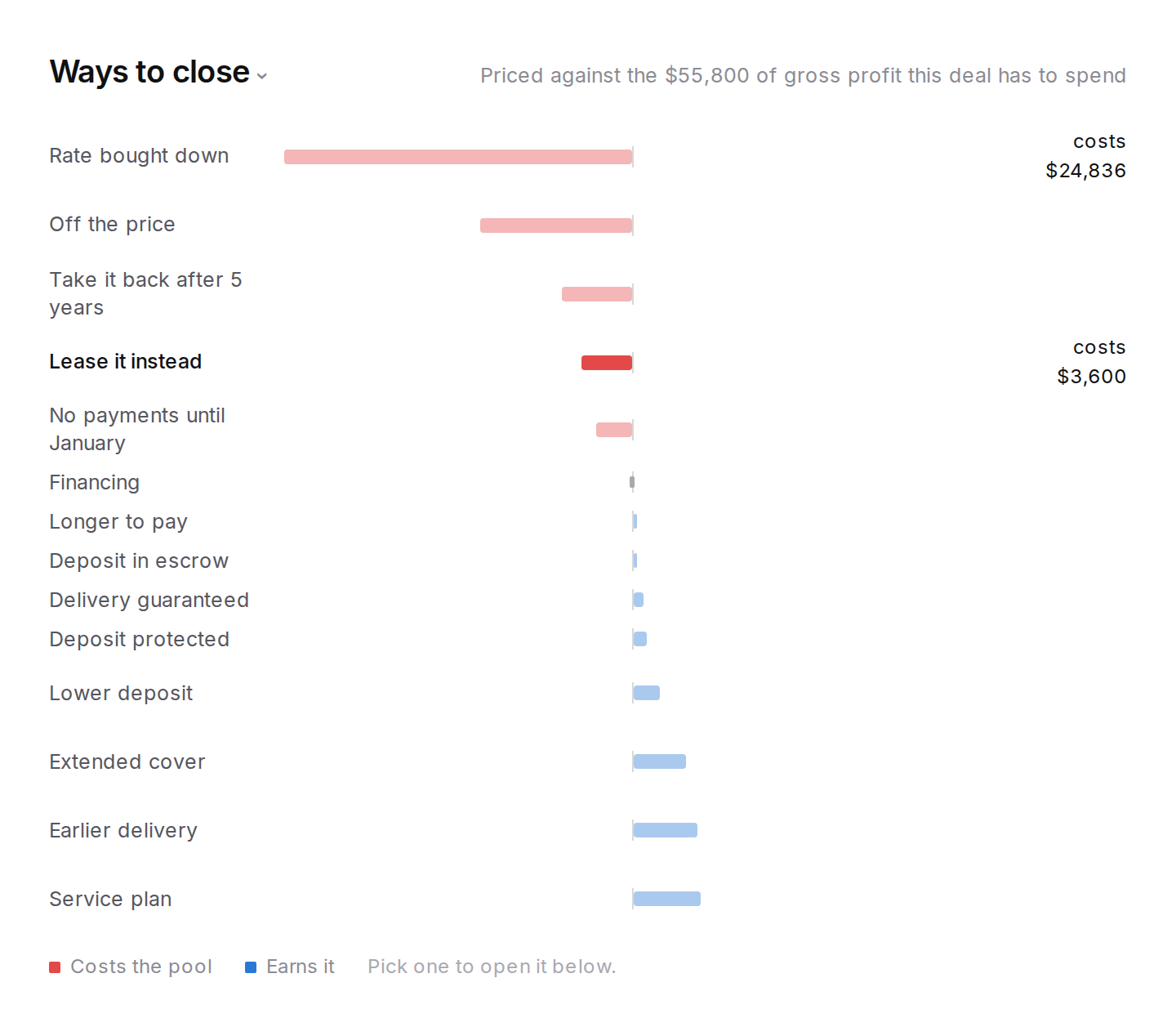
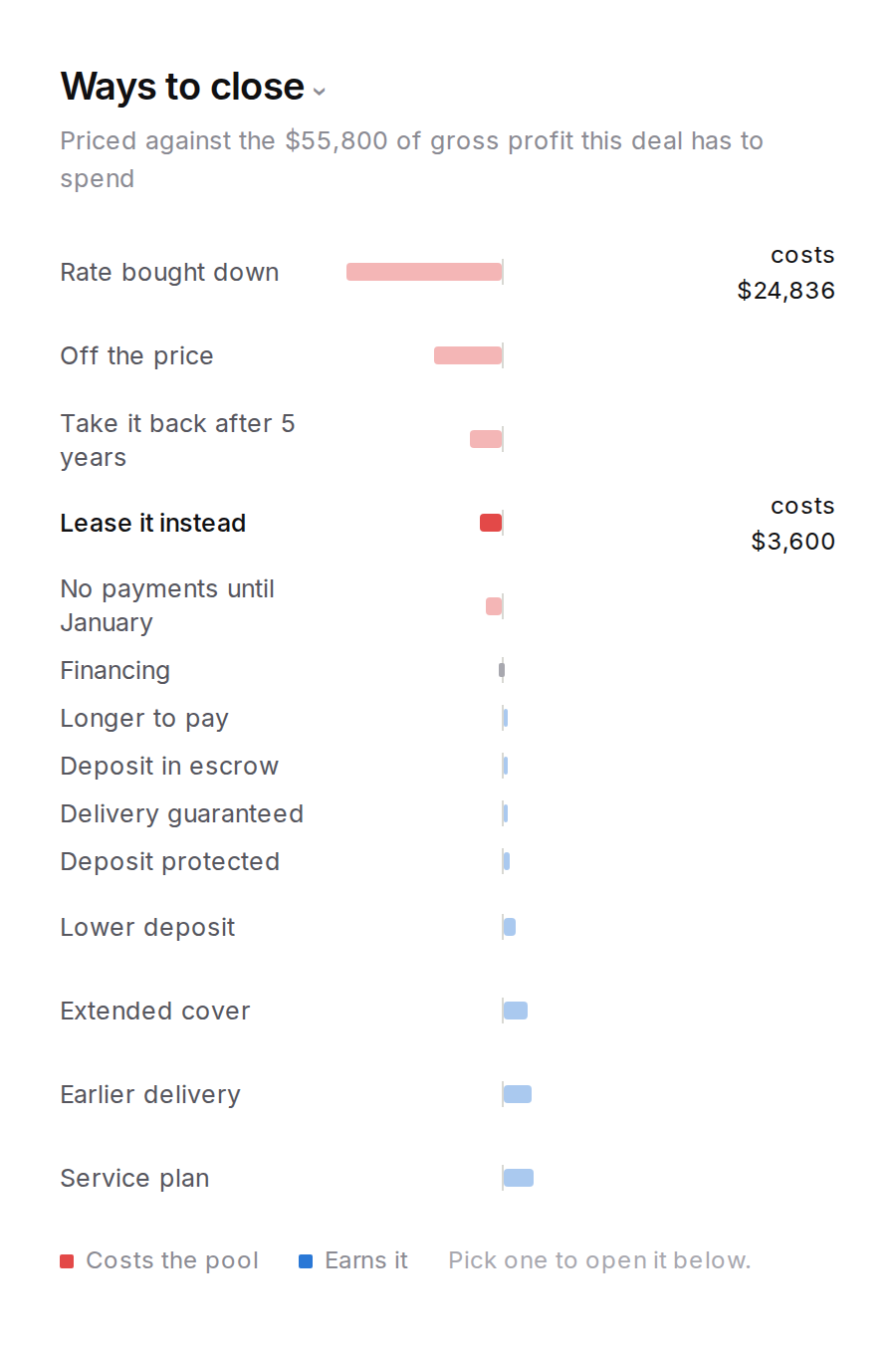
The captive, built out of what you already have.
The largest manufacturers own a finance arm, an insurance arm, a service organization and a used desk. You do not have to own any of them to sell the way they do. We start with whatever you already run, keep it where it works, and bring in the parts you are missing.
- Financing
- We price against the lenders you already use, and put new ones on the panel where yours will not write the deal.
- Leasing
- Your lessor gets named on the quote. If there is no lessor, we arrange the funding to stand a program up, so an operating budget becomes a way to buy.
- Protection
- Your carrier, or one we bring. Deposit, delivery date and specification, written on paper a claim actually pays from.
- Service
- Your own service organization and your own labour rates, priced as an instrument rather than given away. Where there is nothing to price yet, we help assemble it.
- Remarketing
- We work with the used desk you run today, or help build one, so a guaranteed trade-in value is a number your buyer's board can hold you to.
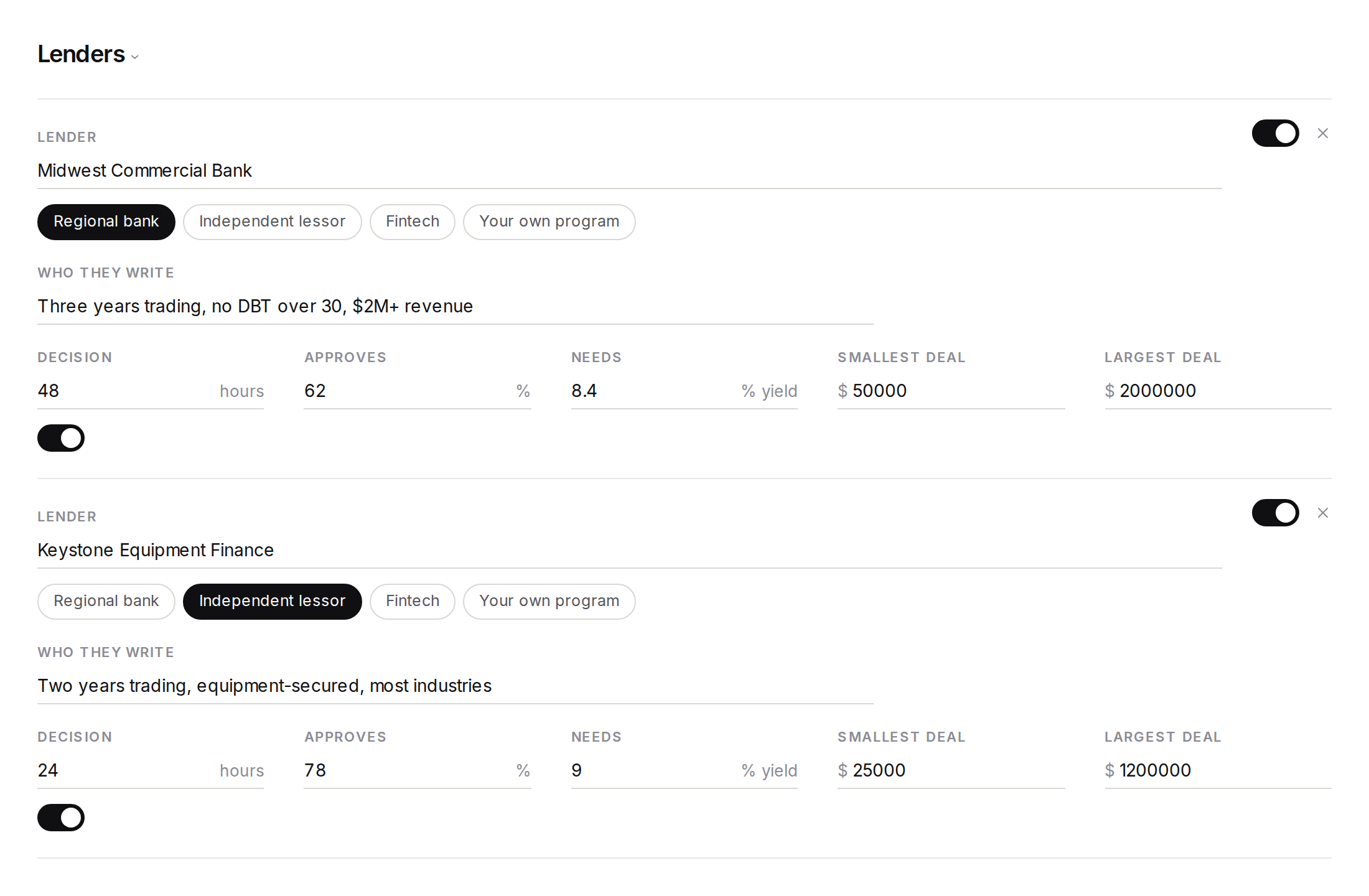
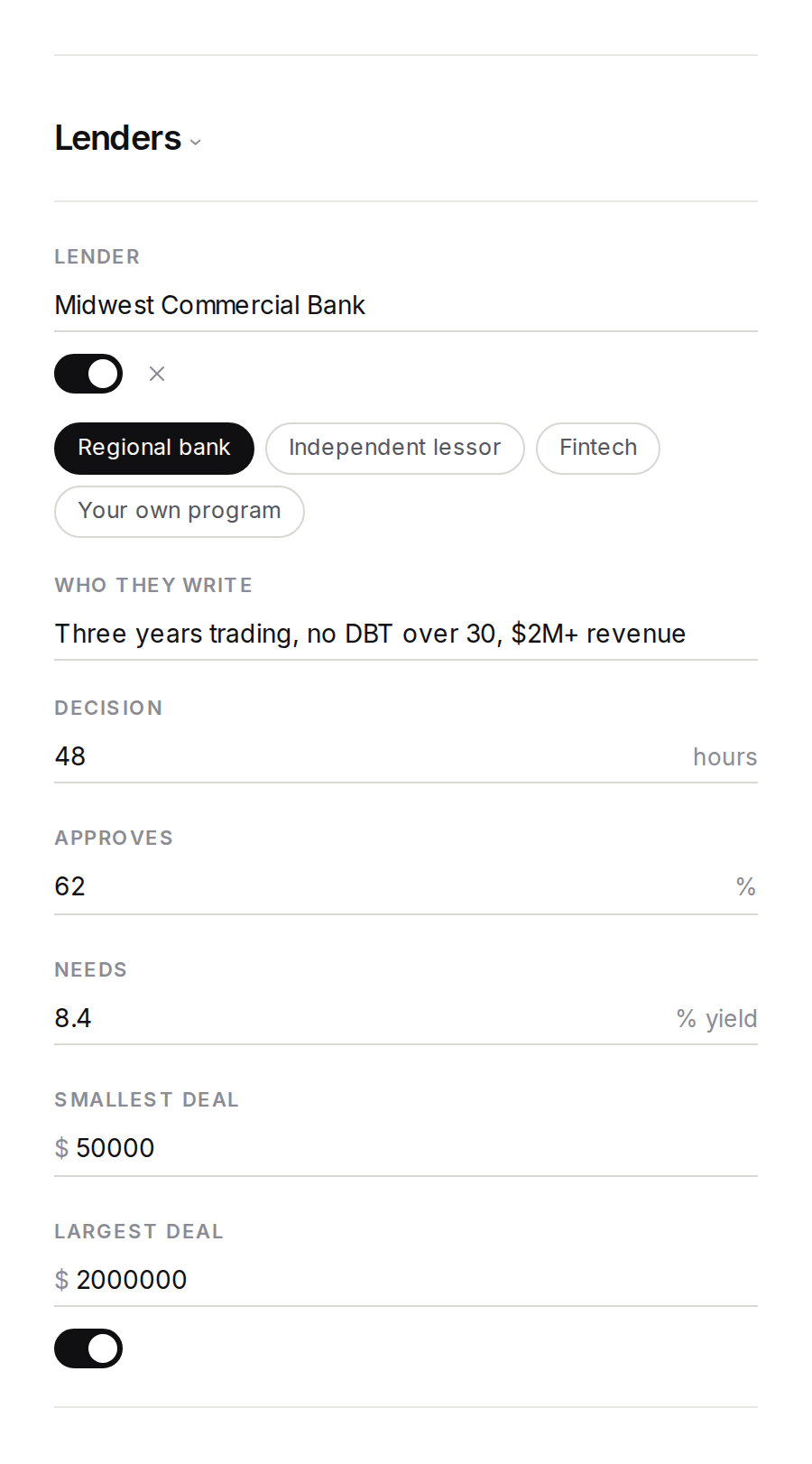
Your panel, in your workspace. Each lender carries who they write, how long they take and what they need to earn, so a deal goes to whoever writes it cheapest rather than to whoever was called first.
Come and look at it on one of your own quotes.
That is the only demonstration we have found convincing, and it is the one we would rather give.